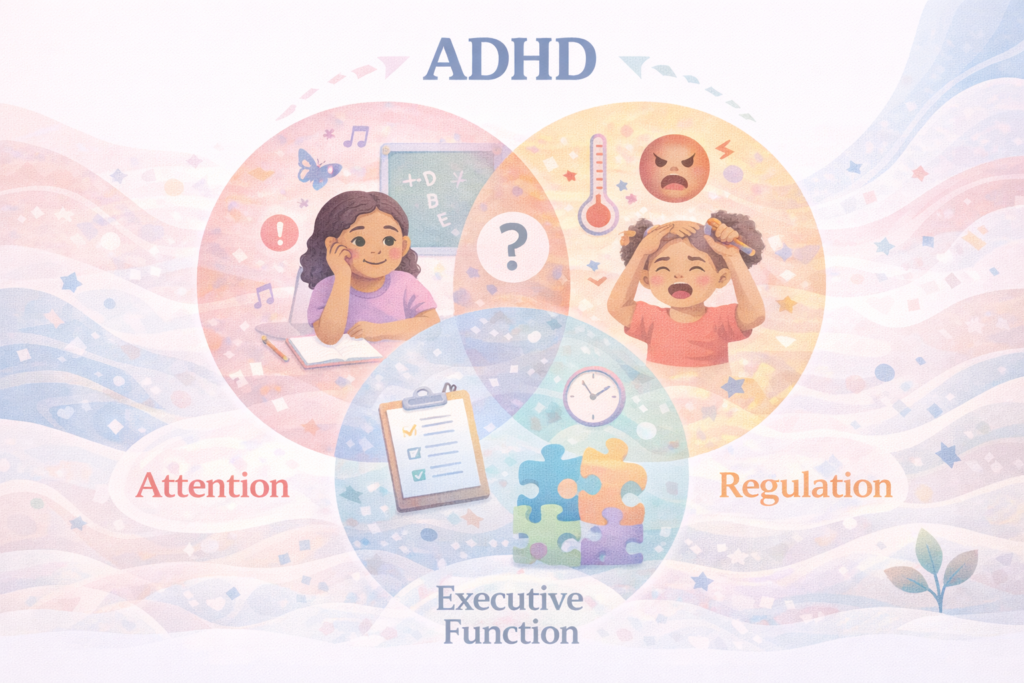
ADHD: attention, regulation & executive function
How attention and control actually work, why “motivation” is a misleading lens, and practical scaffolds.
At a glance
- ADHD is often a regulation and executive‑function condition — not a motivation problem.
- Sleep debt, anxiety, and learning demands can amplify ADHD traits.
- Girls may be under‑identified due to internalising and masking.
If you only do one thing
- Externalise executive function: visible timers, checklists, “first‑then” cards, and fewer steps per task.
ADHD is often about regulation and executive function
ADHD is not a character flaw or a motivation deficit. It is a pattern of attention, activity and impulsivity differences that often reflect executive‑function and self‑regulation challenges.
Executive function is the “air traffic control” system: starting tasks, shifting attention, holding steps in mind, inhibiting impulses, and persisting through boredom.
Why the same child can look “fine” one day and not the next
ADHD traits intensify with sleep debt, sensory overload, anxiety, hunger, pain, and too many transitions. When load is high, the brain has fewer resources for control.
Treat the basics as part of the intervention: predictable routines, movement breaks, and reduced step‑count in tasks.
Girls and under‑recognised ADHD
Many girls present with internalising traits (anxiety, perfectionism, rumination) and may be overlooked because they are not disruptive. Some learn to mask by working harder at school and collapsing at home.
If the child is “holding it together” at school but melting down later, it is still a support need.
Practical scaffolds (the “external brain”)
Make invisible tasks visible: checklists, first‑then cards, timers, and labelled storage. Use fewer steps, not more willpower.
Use interest wisely: pair a hard task with a small interest‑based reward, and keep the reward immediate. Delayed rewards rarely work in young kids.
For transitions, preview and practise: “Two more minutes → shoes → car.”
Overlap patterns
ADHD commonly overlaps with autism traits, learning differences, anxiety, and sleep disruption. When supports don’t work, look for the hidden driver (sleep, sensory pain, task mismatch).